


Many times when we receive a number of emails on a particular subject we will respond with an article like this one. In this case, the subject is boat handing in rough water.
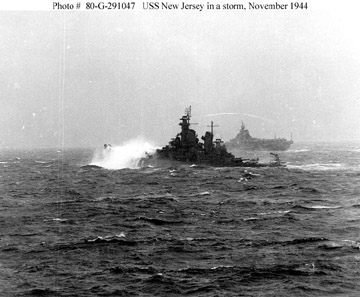
Battleship New Jersey in typhoon. The waves don't look like much until you compare them to the size of the ship. Look closely and you will see that there are waves on top of waves so that there is no uniform wave size
A number of emails addressed the issue of losing control of the boat while running with the seas. Comments ranged anywhere from concluding that their boat had a dangerous defect, to whether they should have bought a catamaran, to whether they shouldn't be considering some other type of boat that will handle better.
Questions such as this point a problem that we've been long familiar with. That problem is a matter of the lack of fundamental boating skills among far too many boat owners. We resist the urge to chuckle at the question because ultimately this is a serious issue. Taking a boat out into open water is serious business, one that requires a comparable degree of knowledge and skill.
Very often novice boaters head out on nice, calm sunny days only to find that conditions suddenly change.
One of our emails spoke of running down wind in up to six foot seas in a 30 foot cruiser and encountering the problem that the boat "for no overt reason would turn violently into the trough." Clearly what the writer is describing is what is known as "broaching," a condition in which a boat runs down the crest of wave, gathering speed, and as it meets the backside of the next wave ahead, buries its bow in that wave. The resistance of the bow hitting the back side of the wave causes the bow to slew around, and the boat to veer sharply off course. There's nothing unusual about that.
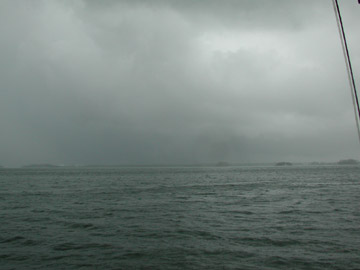
We saw it coming but did not run . . .
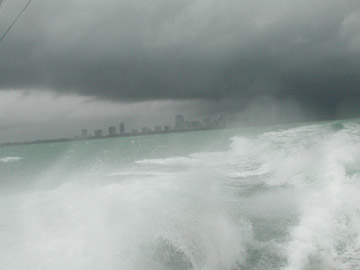
Our sturdy Hatteras was built to take it, But I wouldn't want to test this storm out In a Silverton. . . . . Know your own and your boat's limitations. Smashing into steep four footers in 50 kt winds at 26 kts. is no problem for this 39' boat.
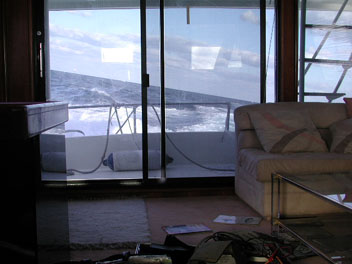
Whereas this 50 foot Motor Yacht has trouble with severe rolling in only three foot following seas.
Typically, the pilot loses control of the boat, passengers are thrown around, and this can even result in capsizing. The problem is not always the design of the boat, but is often a matter of operator error. That the writer did not use term "broaching" was also an indication of his lack of understanding. Instead, the term "tip over" was used, indicating the operator's rather appalling lack of experience. The pilot here was completely unaware that he was operating the boat at too high a speed for the conditions.
Yet, it's not merely a matter of speed, but one of the lack of general seamanship skills. He was unaware that running with high seas can be just as dangerous as heading into them. In fact, he seems to be unaware that taking a 30 foot boat out in 6 foot seas is, itself, a dangerous proposition.
Many people come to believe that just because they've been out in rough water a few times, that they're now "experienced." Not true. Understanding the effects of wind, waves and currents is not an easy subject to master. Waves behave differently under a large variety of different conditions, so that unless one is familiar with all, or at least most of these conditions, then one is not experienced. That's why to get an ocean operator's license from the USCG requires that an applicant prove that they have had a large number of hours under such conditions.
Hull design has a lot to do with how different boats will handle under different conditions. The simple fact is that the vast majority of boats sold today are designed for creature comforts, not rough water performance. The number of boats around that have good rough water capabilities are few and far between. One reason for this is that people are not willing to give up luxury and convenience for good handling characteristics. And so the vast majority of boats are best suited for protected, not open water operation.
This issue points up the reason why many people often express displeasure that this web site doesn't focus more on "family cruisers" and runabouts, the sort of boats more suitable use on inland lakes and rivers. We live and work in an oceanic environment, so that becomes the focal point for our literature. We are not inland boaters and know little about inland boating.
Even the best of boats won't overcome the lack of knowledge and seamanship skills. One could easily take a 29' Blackfin sport fish out in the Gulf Stream and sink it as a result of inadequate piloting skills. Boats that are designed for rough water operation will perform better, but they do not negate the demand for skillful operation.
Broaching is a dangerous condition. There are times when wave conditions will affect any vessel to the point where running downhill presents the danger of broaching. The only way to avoid this is to alter course to a new course where broaching is not a threat.
Once waves reach a certain height, it becomes necessary for the operator to match the speed of the vessel with the speed of the waves, whether he wants to or not. That means slowing down a lot. One cannot stuff the bow into the backside of the wave ahead, without risking the possibility of broaching and losing control. If you permit the boat to go zooming off the front side of the wave, you have to consider the consequences of what happens when you quickly meet the back side of the wave ahead.
Would you drive your car 50 MPH down a road full of foot deep potholes? The analogy is an appropriate one here. You'd end up tearing the wheels off the car, losing control and crashing. When the wind blows, the water becomes full of potholes. And worse.
Negotiating inlets
This is one circumstance where broaching and losing control presents an unusually serious threat, for loss of control can mean crashing into a jetty or going aground or ashore. Severe tide rips occur when an outgoing tide meets incoming seas. The result is very steep waves with a short distance between crests. But it can also occur at places where promontories generate strong currents, or even bottom features below the surface cause unanticipated conditions. Dangerous conditions that occur without warning, unless, of course, you have been educated as to how to anticipate these.
Sure, having a well designed boat helps, but you've got to bring yourself up to speed with equally good seamanship skills. Either that, or risk becoming yet another story on the evening news.
When approaching an inlet with a nasty tide rip, it is best, whenever possible, to approach it as close-in as the water depths will permit. That means approaching the channel from the side. The last thing you want to do is chug through a mile or two of tide rip as many people are prone to do.
To do so safely means that you have to know your water depths outside of the deep channel, and whether or not there are any obstructions. Once you're into the rip with nasty following seas behind you, it's a matter of good seamanship to keep the boat at the right speed and under control.
Finally, be wary of crowded inlets under poor conditions. If there is too much traffic, don't be in a big hurry to join the fray. Wait until traffic lets up some.
* * * * * *One of the things that makes boating so very interesting is that there is so much to be learned. Another is that it can be dangerous, which, for the adventurous just adds some spice to the banquet. The socially oriented recreational boater is unlikely to ever learn much in the way of seamanship; he owns a boat as an avenue for recreation, something to do with family and friends. It's a whole different ball game for the true boater, for whom boating is a hobby or avocation. Him we can call the true yachtsman whether he owns a small outboard or a mega yacht because his real interest lies in challenging the sea, be it an ocean, bay or river.
One major problem that the boat owner has is that most will never have the opportunity to operate enough different boats to be able to discern the difference between a good handling boat and a poor one. The most common complaint is that a boat rolls too much. More often than not, this is the perception of the inexperienced. All boats roll, and in big waves they roll a lot.
If you are on a boat with a flying bridge, keep in mind that the higher up you are, the greater the range of motion will be. It's like sitting on top of a flag pole: that pole does not have to bend many degrees in the wind for the pole sitter to experience a violent range of motion. A person sitting in the cockpit, though he is experiencing the same number of degrees of roll, is moving far less because he is sitting at the base of the radial arm, while the person at the far end of that radial arm is being flung around violently. It's not the boat's fault, it's his fault for wanting to sit up so high.
Seamanship is the ability acquired by a seaman to pilot his vessel skillfully under adverse conditions. It's a skill that involves understanding your boat, wind, waves, tides, currents and geography. Nowadays, operating a boat is regarded as little different than driving a car: just get in and steer the boat around. We see this casual disregard for the need to acquire any kind of boating skills whatsoever on every single weekend at the local marinas where we can observe dozens of boat owners who have yet to learn even how to dock their boats with any degree of skill.
Spending a few hours on Sunday at the local gas dock watching the antics of unskilled boaters can be some of the best free entertainment available. But it's a lot less funny when you happen to be out on the ocean with one of them. Amazingly, I see this all the time with "licensed" captains who have been hired by brokers to operate boats for the day on a survey. These are often young men who have studied the navigation books and have passed a test. But books and tests can't give you hands-on experience, and these young fellows often have little.
Tide Rips
This is so clearly illustrated when they often head straight out an ocean inlet, directly into a tide rip. A tide rip is a condition in which the tide is rushing through a narrow channel against the direction in which the waves are moving, causing the waves to become taller and steeper, with less distance between crests. You do not head directly into a tide rip unless there is no other way to avoid it. To avoid a tide rip you have to know your water depths around the inlet. Just because the channel is marked doesn't always mean that you have to stay in the channel.
For example, the Port Everglades inlet at Ft. Lauderdale has adequately deep water to the south outside the channel. Since the prevailing winds are east/southeasterly, this wide deep inlet can produce a very nasty tide rip. However, it is easily avoided by leaving the market channel to the south, but very rare is the captain I see who ever does this. Instead, they subject us to heavy bashing and plumes of spray for nearly a mile beyond the jetties.

A deep water inlet with a strong tide rip and moderate seas can produce conditions like this. Do you know how to handle it? What would you do if encountering a situation like this?
Why do they do this? Well, because they are not familiar with this famous inlet, though they will surely tell you they are. That, you see, is a fundamental ingredient in this thing called seamanship. It doesn't begin and end with just boats and waves, but also understanding how weather and topography affects the movement of water. Any sailor worth his salt, understands that the contours of the bottom under the water is just as important as knowing shorelines and channels. These are the kind of things that are only taught in master seamanship courses by those who are truly master seamen.
Consider this: It can more comfortable, and safer, cruising in twelve foot waves than six foot waves (under some, but not all, circumstances). How can that be? Well, if you have any understanding of waves at all, you know that it's not the height of the wave that is most important, but the distance between waves. If the distance is very far, as with swells, they can be very large indeed, but not be threatening or causing undue discomfort. Yet a steep four foot chop can be downright dangerous or make your time on the water miserable.
Waves are peculiar things. If you've ever taken the time to actually observe them, you know that the water making up the wave doesn't actually move in a linear direction. No, the water in a wave actually moves in a vertical circle and similar to the way sound waves move through the air or AC current travels through a wire: it undulates. It is caused by friction of the wind on the water surface, obviously. But water is heavy, and does not want to move. Waves rise up because of this resistance of the water which is not pushed around easily.
The point to understand here is that a single wave can weigh dozens of tons, usually much more than your boat, and though water is fluid, it resists the movement of your boat through it. Good seamanship involves choosing the best pathway through the waves, even though that usually doesn't take you in a straight line to your destination. In going from point A to point B, you have to decide whether pounding the boat straight into the waves is preferable to choosing a more comfortable course.
Sailboats cannot sail directly into the wind; instead, they have to tack back and forth at angles in order to travel upwind. A wise motor boat pilot often does the same thing rather than subject his boat and passengers to such abuse. The trick is in figuring out the best angles relative to wave direction, tides and currents.
When waves become large enough, like around four feet for a 30-40 foot boat, all choice in the matter is lost as the waves determine what direction it is even possible to travel in. As waves get yet larger, the distance between crests increases relative to boat length and it may become easier to navigate.
Sea State
Sea state is the term used to indicate, not only wave height, but is also a description of wave life. As winds are increasing and building up wave height, as at the start of a storm, waves will be shorter and steeper. The shape of waves is determined. in part, by how long the wind is blowing at a particular speed. Waves will remain steep as long as wind speed is constant or increasing, but as soon as the wind slackens, wave height and duration will begin to decrease. These waves will be far more comfortable than the waves while winds are constant.
Currents
The next most important factor affecting waves is current. If you ever get the chance to fly over the Gulf Stream, just look down and you can clearly see the effect of the northward flow on the pattern of waves. At each point of the compass, the effect of the current on the direction of the waves is different. The real seaman will understand how this affects waves from all directions.
If the wind is in the same direction as the current, not only will wave height be lower, but distance from crest to crest will increase, making for a more comfortable ride. While winds directly opposite current will make waves short and steep, winds perpendicular to the current will create confused or highly irregular waves that can be equally dangerous. Here, the current works to scatter or break up waves. Wave height will be inconsistent and when winds are very strong, will create what are called "rogue waves."
If you've ever seen two wakes of boats traveling in the same direction come together, then you know exactly what a rogue wave is: it's two waves coming together at oblique angles to form a single, yet larger wave. This is why currents around promontories or sudden changes in bottom topography can create very dangerous conditions. Cape Horn, Cape of Good Hope, Cape Hatteras are all famously dangerous promontories that create very dangerous conditions because they divide two large bodies of water that converge. Thus the waves and currents also converge.
But the conditions caused by the topography of a Cape Horn can be just as easily created on a large bay or lake by a similar topography. Hence boaters can get into big trouble on the likes of Chesapeake Bay as they can those other famous trouble spots. All along our coastlines there are hundreds of spots where wind, current and land mass shapes can cause sudden and unexpected dangerous water conditions. The boater is running along, happy as a clam, in comfortable conditions, and suddenly he is hit by the unexpected.
"We were running along and everything was fine. Then, suddenly we were hit by these huge waves and the boat leaned over so far that my sister on the bridge fell and broke several ribs. The sofa in the salon went from the port side to the starboard side and smashed the cabinets and paneling. Later we learned that the batteries broke loose, which is why we lost power to the radio and couldn't call for help."
Stories such as that were told to me many times in my insurance claims work over the years. When I plotted the location of the mishap on a chart, it usually became very clear why they ran into trouble. Their description of the event was all wrong: they were not suddenly hit by big waves. Oh, no. What they did was pilot their boat into an area containing big waves. The potholes in the road did not jump up and hit the car, the car was driven over the potholes, and had the driver been looking where he was going he could have avoided them.
In such cases the boat operators unknowingly piloted their boats into dangerous waters around promontories or confluences of currents which are predictable if you have the knowledge. In most cases one can plot the trouble spots on a chart if you know how to read one.
Down in the Caribbean there are some spots, such as the Windward and Mona Passages, which are famous for their dangerous waters. These involve very strong tidal flows between major islands. So, too, areas of the lower Chesapeake where all that tidal water flowing out on an ebbing tide around promontories can kick up hellacious seas very unexpectedly to the unknowing, and where hundreds of them get in trouble every year. All because they are unqualified to be operating a boat where they were.
There are times when the trouble spots cannot be avoided, so that good seamanship calls for making preparations for entering areas of dangerous waters, as well as knowing how to pilot the craft through them. Just because you have a fast boat doesn't mean that you can escape from trouble quickly. Once you pilot a boat into troubled waters, you become trapped by them, and only good seamanship will get you out. Lacking such skills, you days on Earth may come to an end.
Bottom Topography
Probably one of the least understood and anticipated influences on wave conditions is bottom topography. Water depth has a major effect on waves which will behave very differently between shallow and deep water.
Waves do not merely affect the surface of a body of water. The motion involved actually goes down fairly deep, around four times the height of the waves. So if a wave is four foot, the water is being disturbed down to a depth of about sixteen feet.
Thus, when you have a situation where the bottom suddenly rises up to near the surface, this can cause nasty sea conditions. There are excellent examples of this in the Bahamas where there are actual underwater cliffs that rise close to the surface.. You can imagine what happens when a current meets a sheer under water wall or very steeply rising shelf. It's much the same thing as the wind flowing around tall buildings. Water moving against a submerged plateau is going to "hump up" at that point.
Not only does the underwater obstruction force a change in water flow direction, but will cause increases in velocity and create nasty eddies. These things can create some of the most dangerous water conditions there are. Like rapids on a river, only a very skilled boatman can handle them.
Even worse is the location where many of these factors come together, such as a promontory and steep underwater shelf, along with a forced increase in water flow and possibly the venturi effect of two headlands coming together. Such places can be serenely placid at one moment, and deadly the next as the slack tide or winds suddenly change.
The foregoing discussion covers the factors that influence waves. In Part II we'll discuss boat handling under those circumstances.
Recommendations For Novices
If you are a novice, I recommend that you do several things.
1. Never rely on GPS electronic maps for your knowledge of the waters you navigate. There is a good reason why, the first screen you see when you turn it on, warns you not to rely on it: it does not contain all the information you need to navigate safely.
2. Buy paper charts of the areas that you intend to navigate, INCLUDING your local area. Learn to read charts and study them. Memorize the geography of the land and the topography of the water.
3. Learn about tidal flows and currents, their direction and velocity. Know the places that are best avoided.
4. When encountering rough water, take the time to be observant of what is happening around you. Use the opportunity to practice and learn boat handling skills.





David Pascoe is a second generation marine surveyor in his family who began his surveying career at age 16 as an apprentice in 1965 as the era of wooden boats was drawing to a close.
Certified by the National Association of Marine Surveyors in 1972, he has conducted over 5,000 pre purchase surveys in addition to having conducted hundreds of boating accident investigations, including fires, sinkings, hull failures and machinery failure analysis.
Over forty years of knowledge and experience are brought to bear in following books. David Pascoe is the author of:
In addition to readers in the United States, boaters and boat industry professionals worldwide from nearly 80 countries have purchased David Pascoe's books, since introduction of his first book in 2001.
In 2012, David Pascoe has retired from marine surveying business at age 65.
On November 23rd, 2018, David Pascoe has passed away at age 71.
Biography - Long version